Posts

LESSON 1.1 INTRODUCING - Strategy for sustainable living.
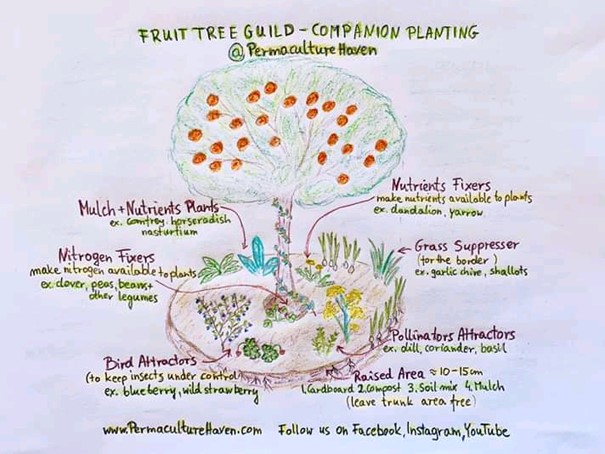
Image
  FOOD FOREST COURSE AGRO -ECONOMY LESSON 1.1  INTRODUCING - S trategy for sustainable living.   Food Forest gardening is a central practice of Permaculture and is an ecological design strategy for sustainable living. Eco systems such as mature rain forests have a huge number of relationships between its component parts. Trees , understory , ground cover , soil , fungi , insects and animals are an integral part of this system.  Plants grow at different heights and this allows a diverse community of life to grow in a relatively small space.  Plants come into leaf and fruit at different times of year.   Edible forest gardens can mimic the complexity of a mature ecosystem and can offer inspiring and practical information of perennial polycultures and of multipurpose plants in small-scale settings. We can apply the principles of a natural ecology to the design of home gardens that mimic forest ecosystems to grow our food, fuel, fodder, fertil...

Lesson 1.2 INTRODUCING – ENCOURAGE MORE IDEAS

Image
    FOOD FOREST COURSE AGRO -ECONOMY Lesson 1.2  INTRODUCING – ENCOURAGE MORE IDEAS   Planting support species which provide soil fertility and mulch on site - grow mulch where you need it. Maximising winter sunlight and summer shade by strategically planting deciduous and evergreen trees. Replacing invasive grasses with non- invasive ground covers, preferably ones that improve soil fertility and offer some food value. Integrating livestock in the system to help minimise work but maximise productivity. Add ponds and habitat for frogs, lizards and birds for built-in pest control. Create swales, drains, and other moisture traps to passively harvest water in the landscape. Create areas that are for your enjoyment such as strategically placed seating or even a  swing. Text from the roots, Elisabeth Ferkonia (Aus.) PDC studied with Bill Mollison.     MORE INFOS: Be more s uccessful with our company as consultant in AGRO - ECONO...

Lesson 1.3 INTRODUCING - SUPPORT-PLANTS

Image
    KOZI YA MSITU WA OOD KILIMO-UCHUMI Somo la 1.2 UTANGULIZI - HIMIZA MAWAZO ZAIDI   Kupanda aina za kusaidia zinazotoa rutuba ya udongo na matandazo kwenye tovuti - panda matandazo pale unapohitaji. Kuongeza mwangaza wa jua wa msimu wa baridi na kivuli cha majira ya joto kwa kupanda kimkakati miti midogo midogo na ya kijani kibichi kila wakati. Kubadilisha nyasi vamizi na mifuniko ya ardhi isiyovamia, ikiwezekana zile zinazoboresha rutuba ya udongo na kutoa thamani ya chakula. Kuunganisha mifugo katika mfumo ili kusaidia kupunguza kazi lakini kuongeza tija. Ongeza mabwawa na makazi ya vyura, mijusi na ndege kwa udhibiti wa wadudu uliojengwa ndani. Unda mawimbi, mifereji ya maji na mitego mingine ya unyevu ili kuvuna maji kwa urahisi katika mazingira. Unda maeneo ambayo ni ya kufurahiya kwako kama vile viti vilivyowekwa kimkakati au hata bembea. Maandishi kutoka kwa mizizi, Elisabeth Ferkonia (Aus.) PDC alisoma na Bill Mollison. MORE INFOS: Be more s uccessful with o...

Lesson 1.4 INTRODUCING – MULTIBLE OUTPUTS.

Image
  FOOD FOREST COURSE AGRO- ECONOMY Lesson 1.4  INTRODUCING – MULTIBLE OUTPUTS. The permaculture design model makes use of connections that are made between components in the final design.   So, in much the same way as there are useful connections between sun, plants, insects and soil so there are also useful connections between different plants and their relationship to the landscape and humans.   Another innovation of the permaculture design is to design a land use or other system that has multiple outputs. A useful connection is viewed as one that maximises power : that is, it maximises the rate of useful energy transformation.   A comparison which illustrates this is between a pig run system and a garden.   If the pigs have access to numerous runs, then all or some of these can be used as gardens to grow crops.   After the crops are harvested then the pigs are allowed into forage and clean up the remaining vegetation. If the run is ...